April 21, 2009 at 9:13 pm
· Filed under Visitors

There is, in Madrid, a fantastic resource called ‘Notes from Spain’ . And as their strap line suggests ‘Travel - Life - Culture’, it is a marvelous amenity as well as being very inciteful and entertaining. Ben Curtis is the author along with his wife Marina Diaz and their site is packed with fantastic stuff. They do ‘podcasts’…. ‘Notes from Spain’, ‘Notes in Spanish’ and ‘Cusine from Spain’, which you can find in ‘iTunes‘. They also have a lively ‘forum’ as well as Spanish tuition.

So good are they that they have just won the ‘Lonely Planet’ travel blog awards for 2009.
And today ‘Cortijada Los Gazquez’ is the ‘guest blogger’ at ‘Notes From Spain’, about which we are very pleased. If you have a moment have a look and maybe make a comment. In the meantime let me say thank you to Ben and Marina for the opportunity to tell a wider audience about our special place.
Permalink
April 19, 2009 at 2:42 pm
· Filed under Creatures
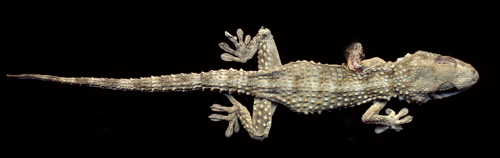
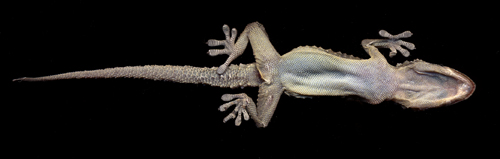
I am happy to stand corrected, but I believe this little fellow is (or was) a Mediterranean Gecko Hemidactylus turcicus. Having lost a leg I assume his lack of mobility led him to fall victim to the dry rigours of underfloor heating. But let us celebrate him in death.
No, he is not ‘the‘ Geronimo, the gecko made famous by Gerald Durrell in ‘My Family and Other Animals’, but he is the same type. I love these little guys and I have little objection to them running up the walls and across the ceilings in pursuit of the less wanted fly or other insect. You can see why they have become such a multifarious corporate logo, their agility and benignity makes them very appealing.
But how do they climb so well? Apparently it’s all down to the Van der Waals force which is the attractive (or repulsive) force between molecules. Intermolecular forces have three ‘attractive’ components, electrostatic interaction, polarization and dispersion which is an attraction experienced by non-polar atoms.
This intermolecular Van der Waals force is called anisotropic which means they are dependent on the relative orientation of the molecules. Random thermal motion around room temperature can overcome or disrupt molecular polarity. However, the thermal averaging effect is much less pronounced for the attractive induction and dispersion forces.
Gecko toes are made with extremely fine hairs called setae. Every square milimeter of a gecko’s foot can hold up to 14,000 of these setae. The consequence is that a vast capillary exchange is how the animal exploits the ‘attractive’ components within molecular cells.
It is believed there is only one surface to which a gecko cannot exploit it’s unique talent and that’s on teflon. So if you are feeling peckish and your larder is a little bare you can always easily fry up a gecko or too. Although you might be better off letting them carry on being your natural insecticide.
Permalink
April 18, 2009 at 4:08 pm
· Filed under Comida, Vida los Velez
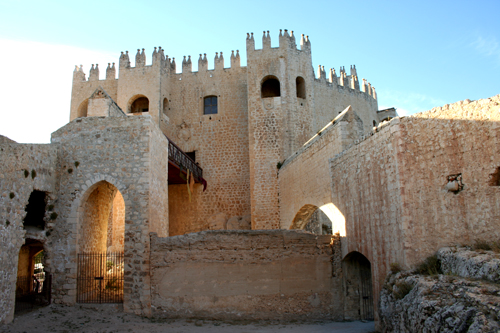
This beautiful Renaissance castle is the ‘Castillo de los Fajardos’ the home of the ‘Marquesas de Los Velez‘ in Velez Blanco. Rather famously the interior patio was sold to an American dealer in the first quarter of the C20th and now resides in New York’s Metropolitan Museum. At the time the family were clearly ‘broke’ and it was an end to a rather famous era.
As always happens, these families become scattered far and wide and inevitably spread within the ‘latin’ world, Brazil being no exception. One such daughter of ‘Los Fajardos‘, being well aware of her family history, whilst surfing on the web happened upon this ‘blog’, based as it is in the home of her ancestors. Since then she, along with her husband Jose, have been following us and have been making great contributions. She, Cecilia Fajardo, has a bond with this place which I understand completely, I being partly of German origin. You always have the feeling that you are from another place.
Whilst discussing the profound goodness and beauty of fresh locally grown vegetables Cecilia sent us this recipe which is a Brazilian national dish. We go to the market in Velez Rubio tomorrow and plan to prepare Dorado baked in salt in the oven with this following dish. Can’t wait.
Salu2 Simon
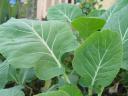
Couve as seen in the nature
In the fryng-pan…
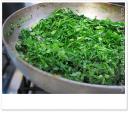
Ready to eat!
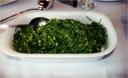
The step by step here:
http://www.portalafro.com.br/aculinaria/couve.htm
This chief is Aparecida “Cidinha”, famous in brazilian tv cooking shows.
The recipe here:
Couve Mineira (Brazilian Garlicky Collard Greens)
1 pound of collard greens, kale or Savoy cabbage
2 tablespoons of sunflower oil or olive oil
garlic to taste
salt to taste
pepper to taste (optional)
1- Wash and drain the kale or the collard greens.
2- Remove the hard stems of the kale.
3- Roll the leaves tightly together and slice into very thin shreds. As the shreds have to be very thin, the knife has to be sharp.
4- Sauté the garlic, the salt and the pepper in the oil (some people add a small union at this step - I don´t).
5- Stir-fry the shredded leaves quickly at high heat. It is important that you stop in time: the leaves have to wilt slightly but should keep their bright color.
Recipe from: DonaBrasil : http://joelens.blogspot.com/2009/02/couve-mineira-brazilian-garlicky.html
Try it, and let us know!
Cecília e José.
Permalink
April 16, 2009 at 7:08 pm
· Filed under Librarius
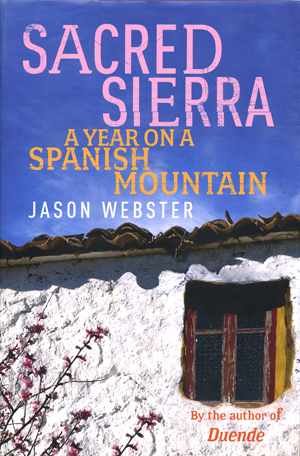
Now they say everyone has a book in them and I am no exception. Except, rather bizarrely, someone else has written mine for me. Except it’s about him. Or rather it’s a book about renovating an old farm and living in the mountains of Castellon. Ok, we are Andalucia, but apart from the language his experiences were the same as ours. (Valencian is more akin to Catalan than Castillian and Andalucian is more akin to Castillian spoken through a pub microphone on music night. You only get to hear part of the word spoken).
It is quite uncanny how similar his experiences were. The strange encounter with hunters, building disasters as a result of inclement weather, having a ‘thing’ about preying mantis, a wife who hates insect life (mine just hates snakes, odd in my book) and like me he is from the north of England. Not that that in itself singles him out as a man living in a parallel universe.
Suffice to say I enjoyed the book immensely, how could I not. It’s a beautiful evocation of life in the southern Spanish mountains, this lifestyle and these people. What I like most is all the background he puts into each chapter, with folk tales and histories and the way they still shape peoples lives here. And best of all for me were the excerpts from Ibn al-Awam’s ‘Kitab al-Falaha’, The Book of Agriculture from a 12th century Moor.
I look forward to reading more. Guerra is his book on the civil war in Spain. Duende is a look inside the world of Flamenco. I feel a small shopping spree at Amazon coming on.
I actually dropped the author an e-mail via his web site to say how uncannily similar his experiences were to ours and I was very surprised to get a reply. He likes our blog too and has promised to make a link from his web page to this ‘if I can work out how to do it’ is what he said. I find that refreshing.
Permalink
April 14, 2009 at 6:22 pm
· Filed under Comida
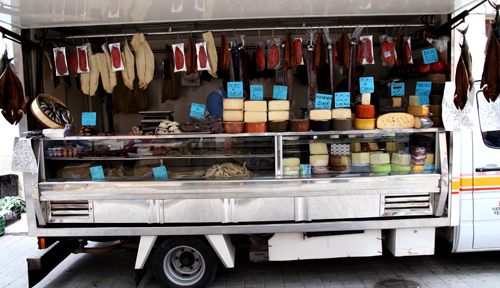
Another fine invention from Andalucia’s cousins across the Straights of Gibraltar, musama, or today more popularly known as mojama. There are many ways of preserving food without the benefit of refrigeration and this is one. When the coast is hot as well as windy and dry what is more obvious than putting sea salt on tuna fillets and hanging them in the sun to dry?
The principle can be applied to any variety of tuna as well as mackrel which would seem preferable. As they dry in the wind they shrink and become dark red. When ready to prepare you slice the fillets so finely that they are transparent. Marinade in olive oil for an hour then serve with toasted almonds. Delicious.
Our man here in Velez Rubio market also sells bacalao, a salted dried cod. There are many stories surrounding the invention of this dish. It was probably originated by the Vikings but I favour the Basques and the notion that they discovered America via the Newfoundland fishing grounds but kept it secret so that they could sell the world bacalao.
Lucky world.
Permalink
April 11, 2009 at 6:52 pm
· Filed under Plantlife
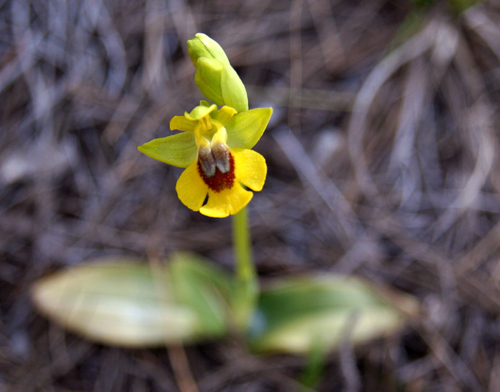
Beneath the chaparrals on the north facing banks of the barranca today we found the Yellow Bee Orchid Ophrys lutea.
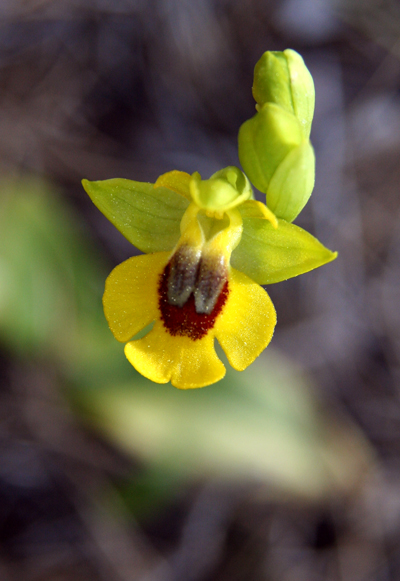
Thanks again to Clive for the rapid identification.
Permalink
April 8, 2009 at 4:17 pm
· Filed under Creatures
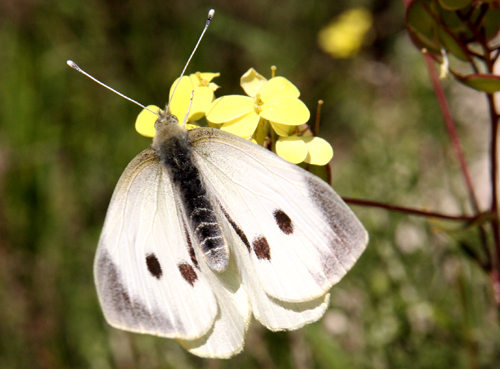
Col being cabbage, mariposa butterfly. It’s still a beautiful creature despite the damage it can cause.
Permalink
April 8, 2009 at 4:14 pm
· Filed under Plantlife
Permalink
April 5, 2009 at 2:27 pm
· Filed under Plantlife
Permalink
April 5, 2009 at 2:21 pm
· Filed under Landscape
When the forecast predicted heavy clouds we awoke to blue skies and warm sunshine. We didn’t expect the clouds to be beneath our feet! This is La Muela (the molar) ‘gums’ shrouded in cloud.
Permalink